
Anatomical and gender diversity: sex for trans, non-binary and intersex people
Bodies change with hormones and surgery, and some are born with variations that textbook diagrams leave out. This guide explains what changes in sex, how to look after the tissues, how to talk about the body without adding to dysphoria, and which practices and positions suit each kind of contact.
Gender, sex and orientation: three different things
Before talking about practices, it helps to separate three ideas that often get mixed up. Gender is how a person lives and names themselves (woman, man, non-binary or other identities). Biological sex describes chromosomes, hormones and anatomy, and it does not always fit two boxes. Sexual orientation is about who you are attracted to.
These three layers are independent. A trans woman may have a penis, a vulva or a neovagina; a trans man may have a vulva, a clitoris enlarged by testosterone or a neophallus; two women or two men may share the same anatomy or not. That is why this guide talks about bodies and types of contact, not "men's sex" or "women's sex". It works just as well for trans, cis, non-binary, intersex or same-gender couples.
What changes with testosterone and with oestrogen
The WPATH Standards of Care (version 8, 2022) describe the expected changes of hormone therapy. Every body responds at its own pace and not every change appears.
| Treatment | Common changes in sex | What helps |
|---|---|---|
| Testosterone | Higher desire for many people; clitoral growth, often with more sensitivity; periods stop; thinner, drier vaginal tissue. | Plenty of lubricant, more time for arousal and, if there is pain, asking about vaginal oestrogen. |
| Oestrogen and blockers | Fewer spontaneous erections, sometimes harder to keep; lower sperm production; lower desire for many people; softer skin. | Exploring pleasure that does not depend on erections: touch, rubbing, toys or stimulating other areas. |
Dryness and atrophy on testosterone. UCSF Transgender Care explains that testosterone creates a low-oestrogen state similar to menopause: vaginal tissue becomes thin, pale and less elastic, and gets irritated by friction. People describe it as feeling like "sandpaper" or burning, and penetration can hurt. An unscented lubricant helps and, if that is not enough, a short course of vaginal oestrogen. According to UCSF, very little is absorbed and it does not interfere with the effects of testosterone.
Testosterone is not contraception. The CDC STI Treatment Guidelines (2021) point out that with a uterus and ovaries ovulation can continue on testosterone and pregnancy is possible. In a survey of 41 trans men who had been pregnant (Light and colleagues, 2014), 61% had used testosterone before the pregnancy, and some conceived while they had no periods. If there is penis-in-vagina contact and pregnancy is not wanted, contraception is needed: progestogen-only and non-hormonal methods are compatible with testosterone. Oestrogen lowers sperm production, but unpredictably, so it does not protect either.
After surgery: neovagina, dilation and other procedures
Each technique and surgical team has its own protocol, and theirs is the one to follow. As a reference, the UCSF Transgender Care vaginoplasty guidance states:
- Dilation. Three times a day for 10 minutes in the first 3 months; once a day from 3 to 6 months; then less and less, down to once or twice a week around the one-year mark. Keep it up for at least a year and dilate more often if depth decreases or it feels tighter.
- Penetration. It can resume from 3 months, unless the team says otherwise.
- Lubrication. The neovagina does not lubricate itself: lubricant is always needed. UCSF recommends water-based ones.
- Prostate. It is kept and can be a source of pleasure, reachable through the wall of the neovagina.
After phalloplasty or metoidioplasty, sensation changes over months and stimulation often focuses on the base, where the clitoral tissue sits. After any surgery, first contact is best without penetration and with the person who had surgery setting the pace.
Dysphoria and how to name the body
For many trans and non-binary people, certain words or certain kinds of touch trigger dysphoria: intense distress about parts of the body or how they are named. There is no vocabulary that suits everyone; there is the one each person chooses.
- Ask what each person calls their body. Some use anatomical words; others use their own terms ("my bits", "front", a made-up name). Use them in bed too.
- Agree on a map of areas. Which parts can be touched, which cannot and which are "it depends on the day". Limits can shift with hormones or after surgery.
- Have a word to stop without explaining, and another for "move somewhere else".
- Clothes count too. Keeping on a T-shirt, a comfortable binder or underwear can make it possible to enjoy sex without thinking about the body. A binder should not be worn for too many hours or during intense effort.
If it is hard to bring up, how to talk to your partner about trying something new has ideas for doing it outside the bedroom and without pressure.
Intersex people and other anatomical variations
The NHS describes differences in sex development (DSD), which many people prefer to call intersex, as a group of rare conditions affecting genes, hormones or reproductive organs. Examples include congenital adrenal hyperplasia, androgen insensitivity, Klinefelter syndrome (XXY) and Rokitansky syndrome (MRKH), where there is no womb and the vagina may be shorter.
What matters most for sex:
- A variation is not an illness that has to be "fixed" to have a full sex life. Many intersex people enjoy sex with no intervention at all.
- Some people had surgery in childhood without being able to choose, and may have scars, less sensation or painful memories. Going slowly and letting that person set the pace is essential.
- If the vagina is shorter, positions where the receiving partner controls depth, plus external stimulation, are usually more comfortable. To lengthen it, the NHS mentions gradual dilation or surgery, always with a specialist team.
The same applies to other common variations: a clitoris or labia of very different sizes, a curved penis, one testicle, scars or stomas. The rule is to adapt contact to the body that is there, not to the one in anatomy diagrams.
Prevention and when to seek help
The CDC guidelines (2021) ask for STI testing to be based on current anatomy and practices, not identity. In practice:
- Get tested at every exposed site: genital, anal and throat. Check how often to get tested for STIs based on what you do.
- If you still have a cervix, you still need cervical screening, whether or not you take testosterone.
- A neovagina can get STIs, so testing there is recommended too. It does not need cervical screening because it has no cervix.
- STIs such as HPV, herpes or trichomoniasis are also passed between two vulvas. Latex barriers and washing or covering toys before sharing them lower the risk.
See a clinician promptly if:
- you bleed after penetration, notice foul-smelling discharge, fever or pain that does not settle, especially after surgery;
- the dilator goes in less and less or hurts more;
- you take testosterone, have a uterus and miss a period that had come back, or think you might be pregnant;
- pain with penetration persists despite lubricant;
- dysphoria or anxiety stops you enjoying sex or makes you avoid contact.
Practices and positions by type of contact
Grouped by type of contact, not by gender. Choose according to the bodies you have today, the areas each person wants to include and the stage of recovery after surgery.
Pleasure without penetration

Erotic MassageBajo
Whole-body touch without focusing on the genitals: useful after surgery or on dysphoric days, and for finding out how skin responds on hormones.

Mutual Manual StimulationBajo
Each person guides the other's hand and names their areas their own way. A pressure-free way to explore an enlarged clitoris or a neovagina.

Tantric Sex (Slow Sex)Bajo
Seated in an embrace, with no goal: the slow pace helps when erections are less predictable on oestrogen or desire builds slowly.
Rubbing and external genital contact

The ScissorsBajo
Vulva to vulva, or any combination, without penetration. Whoever moves chooses pressure and angle; add lubricant if there is dryness.

Frottage (Body Rubbing)Bajo
Rubbing with or without clothes: anyone who prefers not to expose certain areas can enjoy contact while keeping underwear or a binder on.
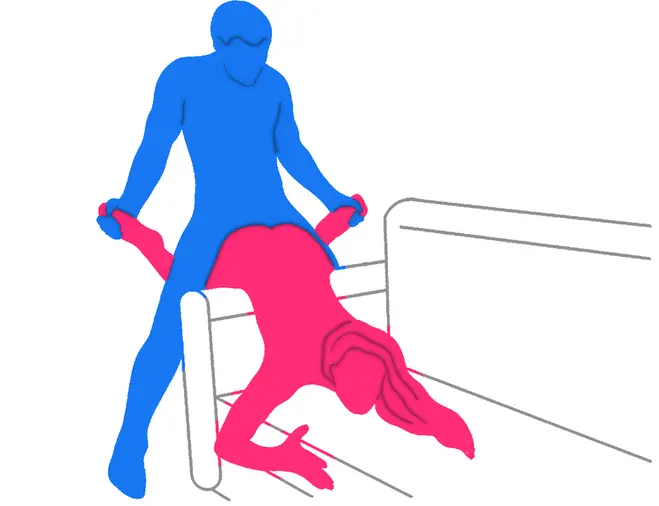
The Cobra (Embracing Hug)Bajo
Face to face and wrapped together with short rocking: lots of pelvic contact and little demand for an erection or penetration.

The Lotus FlowerBajo
Seated and intertwined, with hands free to stimulate. A good option when penetration is not yet allowed after surgery.
Oral sex
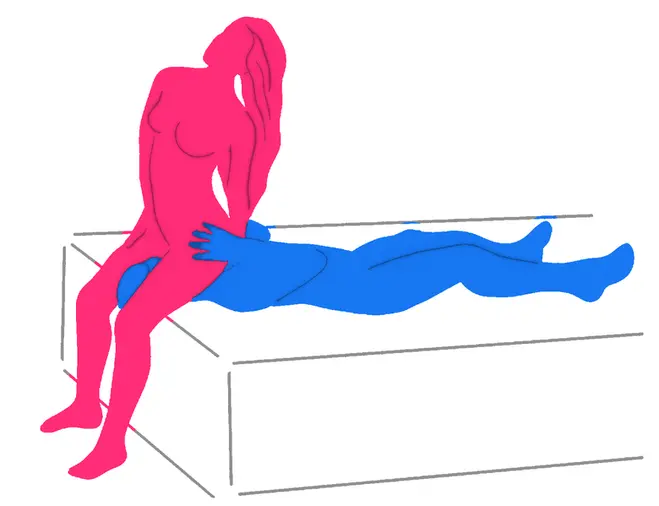
The Queen's ChairBajo
Oral sex on a vulva or neovagina with the receiving partner on top and in control of pressure. Use a latex barrier if there is an STI risk.

Oral Sex on the Penis (Fellatio)Bajo
For a receiving partner who wants to include the penis; agree beforehand on areas and words. On oestrogen, a full erection is not needed to enjoy it.

The 69Bajo
Mutual, simultaneous oral sex that works with any combination of anatomies. Each person decides which part of their body to include.
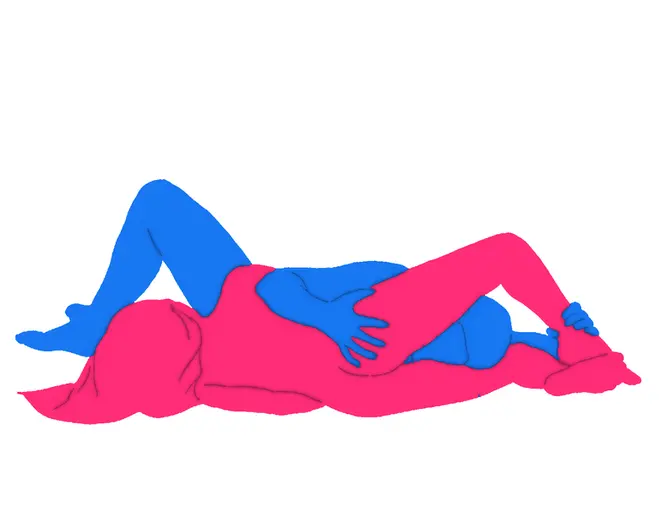
The ScorpionBajo
A side-lying version of mutual oral sex: no weight-bearing, easier on necks and backs and simple to pause.
Penetration with the receiving partner in control

The CowgirlMedio
The receiving partner is on top and decides how deep and how fast. Useful with a new neovagina or with tissue thinned by testosterone.

On a Chair (Straddling)Bajo
Straddling on a chair, the receiving partner regulates depth with their feet on the floor. Leaning forward reduces how deep it goes.

The SpoonBajo
Side-lying, with little depth and no weight-bearing: comfortable for returning to penetration after surgery or with dryness.

The MissionaryBajo
Face to face, with eye contact to read signals. The receiving partner can set the pace with their hands; a cushion under the hips changes the angle.
Best left for later
While recovering from surgery, or while there is dryness or pain, it is best to avoid:
- positions that give a lot of depth or take control away from the receiving partner (legs over the shoulders, raised pelvis, vigorous penetration from behind);
- any penetration before the surgical team allows it, even if dilation is going well;
- scented, warming or numbing lubricants, which irritate thin tissue and mask the pain that acts as a warning;
- practices that touch areas the person has not included in the agreed map.
Keep reading
Articles
Definitions
Infections
Frequently asked questions
Does testosterone work as contraception?
No. With a uterus and ovaries you can ovulate even without periods, and pregnancies have been documented in people taking testosterone. If there is penis-in-vagina contact, use a compatible method of contraception.
Why does penetration hurt since I started testosterone?
Testosterone thins and dries the vaginal tissue, which gets irritated by friction. Plenty of lubricant and more time for arousal help; if that is not enough, ask about vaginal oestrogen, which is barely absorbed.
How long do you need to dilate after vaginoplasty?
At least a year, very often in the first months and less afterwards, following your surgical team's protocol. If you notice less depth or more tightness, dilate more often and get advice.
When can you have penetrative sex after vaginoplasty?
UCSF guidance mentions around three months, as long as the surgical team agrees. Before that, you can enjoy touch and non-penetrative contact.
Do trans people need different STI tests?
Tests are chosen according to current anatomy and practices: at every exposed site, including a neovagina. If you still have a cervix, you still need cervical screening.
How do I talk about my body with my partner if I have dysphoria?
Choose the words for your own areas and share them beforehand, outside the bedroom. Agree on what can be touched, what cannot, and a word to stop without explaining.
Sources
- Coleman E, Radix AE, Bouman WP, et al. Standards of Care for the Health of Transgender and Gender Diverse People, Version 8. International Journal of Transgender Health. 2022;23(Suppl 1):S1-S259. doi.org
- Centers for Disease Control and Prevention (CDC). Transgender and Gender Diverse Persons. Sexually Transmitted Infections Treatment Guidelines. 2021. www.cdc.gov
- UCSF Gender Affirming Health Program. Vaginoplasty procedures, complications and aftercare. Guidelines for the Primary and Gender-Affirming Care of Transgender and Gender Nonbinary People. 2016. transcare.ucsf.edu
- Obedin-Maliver J. Pelvic pain and persistent menses in transgender men. UCSF Gender Affirming Health Program. 2016. transcare.ucsf.edu
- Light AD, Obedin-Maliver J, Sevelius JM, Kerns JL. Transgender men who experienced pregnancy after female-to-male gender transitioning. Obstetrics & Gynecology. 2014;124(6):1120-1127. doi.org
- NHS. Differences in sex development. nhs.uk. 2023. www.nhs.uk
This guide is educational and does not replace assessment by a health professional. After surgery, always follow your surgical team's protocol and seek help if you have bleeding, fever or severe pain.