
Sex and intimacy in pregnancy and after birth
Pregnancy and the months after birth change your body, your desire and your time as a couple. This guide sums up what changes during pregnancy and focuses on the postnatal period: when to have sex again, which contraception to use, how to deal with dryness and pain, and which positions are most comfortable at each stage.
During pregnancy: the essentials
If your pregnancy is going well, sex does not harm the baby: it is protected by the amniotic fluid, the womb and the mucus plug in the cervix. What does change, trimester by trimester, is desire and comfort:
- First trimester: nausea, tiredness and tender breasts lower desire for many people.
- Second trimester: often the most comfortable stage; sickness eases and the extra blood flow to the pelvis can heighten sensitivity.
- Third trimester: the bump, weight and fatigue limit positions; side-lying, seated and pregnant-partner-on-top positions work best.
From the second trimester it is better not to lie flat on your back for long, as the weight of the womb can press on major blood vessels and make you feel dizzy.
When to avoid sex or check first: if you have vaginal bleeding, leaking fluid, placenta praevia, a risk of premature labour, pain or contractions that don't settle, or if your care team has advised against it. We cover this in our article on sex during pregnancy.
After birth: when to have sex again
There is no fixed date. The NHS puts it simply: there are no rules about when to start having sex again after giving birth. Mayo Clinic generally advises waiting until your postnatal check, after both vaginal and caesarean births, because the risk of complications is highest in the first two weeks.
Two practical signs can help you decide:
- The lochia has stopped. According to the NHS, postnatal bleeding usually stops after 6 to 8 weeks, although it can last longer.
- You feel ready, physically and emotionally. You have nothing to prove, and penetration is not the only way to be intimate.
Everyone's pace is different. In an Australian study of 1,244 first-time mothers published in BJOG, 78% had resumed penetrative sex by 3 months and 94% by 6 months. If it takes you longer, that is normal too.
Contraception after birth
Ovulation can return before your first period, so you can get pregnant without having had one. The NHS says this can happen from 21 days after the birth, even if you are breastfeeding, and recommends waiting at least 12 months before your next pregnancy. It is worth choosing a method before you have sex again.
| Method | When you can start (NHS) |
|---|---|
| Implant, injection, progestogen-only pill, condoms | Any time after birth, including while breastfeeding |
| Copper or hormonal IUD | Within 48 hours of birth or from 4 weeks |
| Combined pill, vaginal ring or patch | From 3 weeks if not breastfeeding and with no blood clot risk; if breastfeeding, usually from 6 weeks |
| Diaphragm or cap | From around 6 weeks, after being refitted |
The lactational amenorrhoea method (LAM) only protects you if all three conditions are met at once: you are breastfeeding exclusively (your baby has nothing but breast milk), your baby is under 6 months and your periods have not returned. The American College of Obstetricians and Gynecologists (ACOG) adds that feeds should be no more than 4 hours apart during the day and 6 hours at night. As soon as one condition no longer applies, you need another method. All the options are in main contraceptive methods.
Dryness, pain and the pelvic floor
Dryness. Oestrogen drops after birth and stays low while you breastfeed. Your vagina may feel drier and more sensitive, even if you have never needed lubricant before. A water- or silicone-based lubricant usually helps; here is how to choose a lubricant.
Pain after a tear or episiotomy. Some discomfort the first few times is common. In the Australian study above, 44.7% of mothers had pain during sex 3 months after birth and 23.4% still did at 18 months. It helps to start slowly, with plenty of arousal first, lubricant and positions in which the person who gave birth controls depth. Mayo Clinic also suggests emptying your bladder beforehand and taking a warm bath. If the pain is still there at your postnatal check, see your GP: there may be scar tissue that needs treatment.
Pelvic floor. Pregnancy and birth stretch these muscles, which can show up as bladder leaks or a change in how sex feels. Mayo Clinic suggests Kegel exercises: tighten these muscles as if lifting a marble, hold for 3 seconds, relax for 3 and gradually build up to 10 to 15 repetitions, at least 3 times a day. If you have leaks, heaviness or pain, pelvic health physiotherapy is the next step. We explain it in our pelvic health and pain guide.
Tiredness, your relationship and your mood
Little sleep, caring for a baby and a body that is still recovering all lower desire. That is to be expected, not a failure of the relationship. It often helps to:
- Talk about what you feel like and what you don't, without assuming you have to go back to your old routine.
- Find short moments alone, even 15 minutes, and accept that desire often turns up once touch has begun.
- Value touch without penetration: caresses, massage or falling asleep cuddled up all count.
If a mismatch in desire drags on and causes tension, our article on desire discrepancy in couples may help.
Postnatal depression. In the first few days it is normal to feel tearful or emotional (the "baby blues"); the NHS says this usually passes within 2 weeks. If low mood, anxiety or loss of interest last longer, it may be postnatal depression. According to the World Health Organization, around 13% of women worldwide who have just given birth have a mental health condition, mainly depression. It can start up to a year after the birth, and partners can be affected too. It can be treated, and asking for help early makes recovery easier.
When to get help
- Urgent: sudden, very heavy bleeding, feeling faint or dizzy, or a pounding heartbeat after the birth.
- A temperature above 38°C, an unusual smell, clots, bleeding that gets heavier, or tummy or perineal pain that gets worse: these can be signs of infection.
- Pain during sex that is still there at your postnatal check or isn't improving.
- Leaking urine or faeces, or a feeling of a bulge or heaviness in the vagina.
- Low mood, anxiety or loss of interest lasting more than two weeks, or thoughts of harming yourself or your baby: seek help the same day.
- During pregnancy: bleeding, leaking fluid or contractions after sex.
Comfortable positions in pregnancy and after birth
A selection by stage. In pregnancy, support matters most, along with not lying on your back for long; after birth, the person who gave birth should control depth, with no pressure on the perineum.
Pregnancy: side-lying, on top or seated

The SpoonBajo
Side-lying with the bump free and no weight on the abdomen. A pillow between the knees or under the bump adds support in the third trimester.

The CowgirlMedio
The pregnant partner is on top and sets the pace and depth. Leaning back leaves room for the bump.

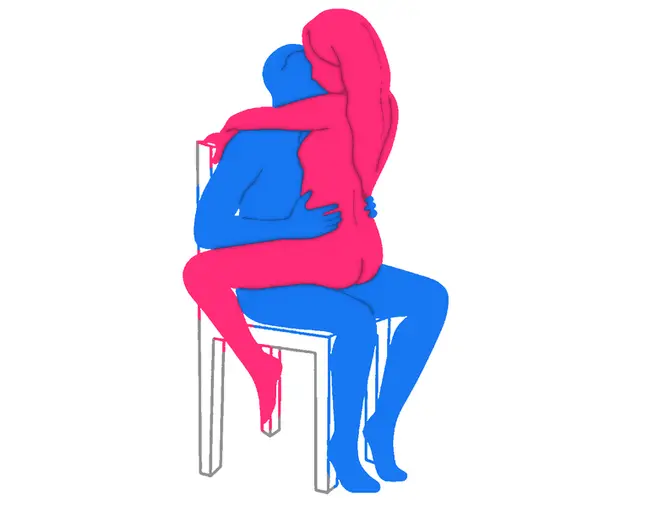
On a Chair (Straddling)Bajo
Straddling a sturdy chair with feet on the floor: the bump stays free and there is no need to lie on your back.
Tantric Sex (Slow Sex)Bajo
A seated face-to-face embrace with slow movement: little effort, lots of contact and no pressure on the bump.

The Half Moon EncounterBajo
Side-lying, face to face and cuddled up: comfortable while the bump still lets you get close from the front.
After birth: control of depth and no pressure on the perineum
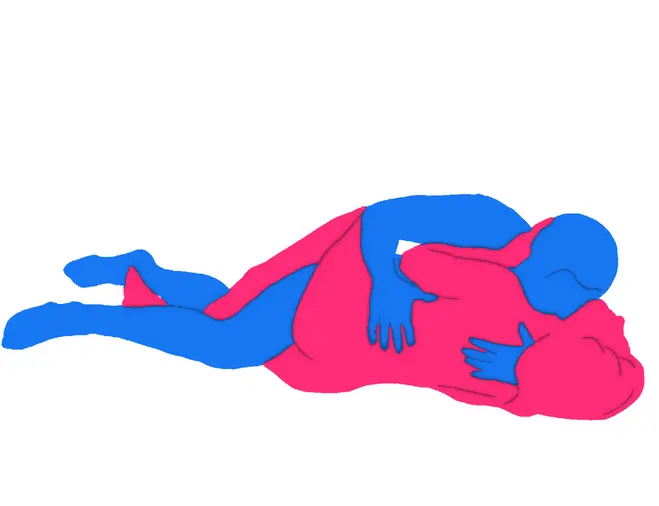
Deep LongingBajo
Side-lying, face to face with shallow penetration: movements are short and the person who gave birth can stop at any moment.

The Venus MirrorMedio
Shallow side-lying penetration; pressing the thighs together limits depth and protects a recent scar.

The SpiralBajo
The receiving partner lies on their side at the edge of the bed with no weight on top; the standing partner can easily adjust the angle.

Side-by-Side Face to FaceBajo
Lying on your sides facing each other, with no weight on the pelvis: a good choice for the first times after birth.
Without penetration

Best left for later
In pregnancy, from the second trimester, it is best to avoid:
- spending a long time lying flat on your back;
- positions that put weight on the bump or squash it;
- positions that need a lot of balance or effort, as your centre of gravity shifts.
After birth, while the perineum or scar is healing:
- deep-penetration positions, such as those that raise the pelvis or put the legs over the shoulders;
- positions that put your full weight on the perineum or the caesarean scar;
- sudden or long movements if there is still pain.
Keep reading
Articles
Contraception and reproduction
Position lists
Other guides
Frequently asked questions
How long should you wait to have sex after giving birth?
There is no set time. Most people wait until the lochia has stopped and they feel ready; many wait until their postnatal check at around 6 to 8 weeks.
Can I get pregnant before my period comes back?
Yes. Ovulation comes before your first period, and the NHS says you can get pregnant from 21 days after birth, even if you are breastfeeding.
Does breastfeeding work as contraception?
Only if you are breastfeeding exclusively, your baby is under 6 months and your periods have not returned. If any of these no longer applies, you need another method.
Is it normal for sex to hurt the first time after giving birth?
Some discomfort is common, especially after a tear or episiotomy. Go slowly and use lubricant; if the pain is still there at your postnatal check, see your GP.
Why is my vagina dry while I'm breastfeeding?
Breastfeeding keeps oestrogen low, which reduces natural lubrication. A water- or silicone-based lubricant is usually enough, and things tend to improve as you cut down or stop breastfeeding.
What is the best position in late pregnancy?
Side-lying positions such as spooning, seated positions and those with the pregnant partner on top: they don't squash the bump and avoid long spells on your back.
Sources
- NHS. Sex and contraception after birth. NHS website. 2026. www.nhs.uk
- NHS. Early days (after the birth). NHS website. 2026. www.nhs.uk
- Mayo Clinic Staff. Sex after pregnancy: Set your own timeline. Mayo Clinic. Consultado en 2026. www.mayoclinic.org
- American College of Obstetricians and Gynecologists (ACOG). Postpartum Birth Control. ACOG Frequently Asked Questions. 2023. www.acog.org
- McDonald EA, Gartland D, Small R, Brown SJ. Dyspareunia and childbirth: a prospective cohort study. BJOG: An International Journal of Obstetrics & Gynaecology. 2015. doi:10.1111/1471-0528.13263. doi.org
- World Health Organization. Maternal mental health. WHO. Consultado en 2026. www.who.int
- NHS. Postnatal depression: overview. NHS website. 2026. www.nhs.uk
This guide is for education and does not replace assessment by a health professional. If you have heavy bleeding, a fever, worsening pain or low mood that isn't lifting, talk to your midwife or GP.