
Ribera: side-lying rear entry with the bodies at right angles
Ribera is a side-lying rear-entry position in which the two bodies form an angle rather than a line. The receiving partner lies on their side and folds at the hips into an L, with both legs straight, held together and stretched out in front, hands holding the ankles. The penetrating partner lies on their side behind the receiving partner's pelvis, torso roughly perpendicular to theirs, propped on one elbow with the head resting on the hand. Penetration, vaginal or anal, is of medium depth and the penetrating partner sets the pace. There is no eye contact and body contact is limited to the pelvis, buttocks and one hand.
Also known as: Riverside · L-shaped side entry

Anatomy and biomechanics
The receiving partner lies on one side, head on the bed, and bends forward at the hips until the legs point straight out in front at about 90 degrees to the torso; the legs stay straight and together, and the hands reach forward to hold the ankles or feet. This offers the buttocks and the entrance to the vagina or anus towards the back. The penetrating partner lies on their side behind the receiving partner's pelvis, with their torso roughly at a right angle to the receiving partner's, propped on one elbow with the head resting on the hand; the free hand rests on the receiving partner's buttock or hip. Both partners' legs run parallel. The penetrating partner moves from the hips with short strokes, and penetration is of medium depth. Holding the legs straight requires some hamstring and hip flexibility in the receiving partner.
Why this position works
Neither partner has to hold their body weight up, so the effort is low for both. Folding at the hips changes the angle of entry compared with an ordinary spoon, and some people find the sensation different or more pronounced. The penetrating partner has a clear view and a free hand to guide the hips. It is not a face-to-face or cuddling position: contact is limited and there is no eye contact, so it suits couples who want to try a different angle rather than closeness. Sensations vary from person to person.
Variations of this position
Variation 1: knees slightly bent
The same L shape, but the receiving partner bends the knees a little and holds the shins instead of the ankles.
Bending the knees takes most of the stretch off the hamstrings, so the fold at the hips is easier to hold for longer. The pelvis stays in the same place, so the penetrating partner does not need to change position.
- Start in the basic position, both lying on your sides at right angles.
- The receiving partner bends the knees slightly, keeping the legs together.
- They hold the shins or rest the hands on the knees instead of reaching for the ankles.
- The penetrating partner keeps the same short, steady strokes.
Variation 2: with a pillow under the hip
The same position, with a firm pillow under the receiving partner's lower hip to raise the pelvis slightly.
The pillow lifts the receiving partner's pelvis a few centimetres, which can bring it level with the penetrating partner's hips and make entry easier when the two have different builds. It also changes the angle slightly.
- The receiving partner lies on their side and places a firm pillow under the lower hip.
- They fold into the L, legs straight or slightly bent.
- The penetrating partner lies behind, propped on the elbow, and adjusts until their hips are level with the raised pelvis.
- Start with slow strokes and adjust the pillow if needed.
Variation 3: penetrating partner lying fully down
The penetrating partner drops the elbow and lies with the head on a pillow, moving only from the hips.
Without the elbow prop, the penetrating partner rests completely and the shoulder is not loaded. Movements become smaller and slower, which suits a calmer pace or longer sessions.
- Start in the basic position.
- The penetrating partner places a pillow under their head and lowers the elbow.
- They keep the free hand on the receiving partner's hip to stay in place.
- Move with small, slow hip movements.
✓ Tips
- Only fold as far as your hamstrings allow: if straight legs pull or hurt, bend the knees slightly.
- The receiving partner can let go of the ankles and rest the hands on the shins or the bed if holding them becomes tiring.
- The penetrating partner should adjust their distance and the angle of their torso until entry is comfortable, rather than forcing the receiving partner's pelvis back.
- Use lubricant, and a condom to reduce the risk of STIs.
- For anal sex, use plenty of lubricant and a condom, go slowly and stop if there is pain.
- Talk about depth and pace: with the receiving partner folded, deeper strokes may feel stronger than in other side-lying positions.
Key facts
- Interaction type
- Vaginal or anal penetration from behind, side-lying at right angles
- Active anatomy
- Penis
- Receptive anatomy
- Vagina or anus
- Main stimulation
- Vagina or anus, with medium-depth penetration from behind
- Setups and participants
- Couple · 2 people Hetero
Frequently asked questions
How is Ribera different from spooning?
In spooning both bodies lie in line and close together. In Ribera the bodies form a right angle: the receiving partner folds into an L with straight legs, and the penetrating partner lies behind their pelvis, propped on an elbow, with little body contact.
Do you need to be flexible?
A little. The receiving partner keeps the legs straight at roughly 90 degrees to the torso, which stretches the hamstrings. Bending the knees slightly makes it much easier.
Can it be used for anal sex?
Yes. Use plenty of lubricant and a condom, go slowly and let the receiving partner say how fast and how deep. Stop if there is pain.
Is it a tiring position?
Not especially: both partners lie on the bed. The main demand is the receiving partner's flexibility, and the penetrating partner's shoulder if they stay on the elbow for a long time.
Safety and evidence
Scientific context for common terms used on this page. Keeping these terms makes the content easier to understand; the sources clarify what is established and what remains uncertain.
G-spot: what the evidence says
“G-spot” is a widely used term for a sensitive area of the anterior vaginal wall. Scientific literature has not established a discrete anatomical structure with an agreed location, size and nature; sensitivity and response can vary between individuals.
A-spot / AFE zone: limited evidence
The “A-spot” or AFE zone has been proposed to describe a deeper area of the anterior vaginal wall. Available evidence is limited and does not support presenting it as a confirmed anatomical structure.
Reviewed by the editorial team ·
Related sex positions

Pleasure Bench
The penetrating partner forms a bench in a reverse tabletop, hands and feet on the floor; the receiving partner sits…

Deep Initiation
A rear-entry position: she crouches on her hands and the balls of her feet, knees off the floor, while he kneels…

Surfboard
Posterior penetration position with G-spot stimulation.

Bright Moon
The receiving partner lies on their back with legs open and stretched past their partner's hips; the penetrating…

Sleeping Beauty
The receiver lies flat face down with a cushion under the pelvis; the partner holds a high plank above, without…

Corona
Reverse seated position: she sits upright on his pelvis facing his feet, legs stretched straight out between his…
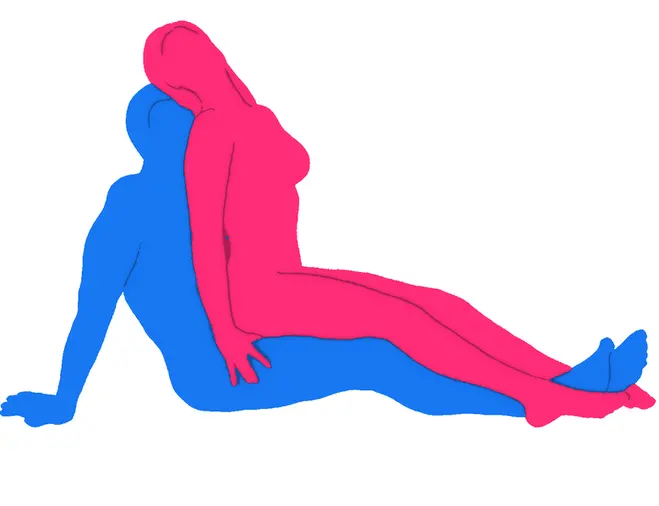
The Rocking
Seated on the floor: the receiver sits on the partner's lap facing away, legs stretched forward, while the partner…

Seated Face to Face, Leaning Back on Hands
Seated position, with vertical contact and A-spot, G-spot stimulation.

The Chocolate Hug
Posterior penetration position with G-spot stimulation.

Launch Pad
She lies on her back with her hips raised on his thighs and her legs pulled up together; he kneels upright and…

The Crab
Face-to-face position on the floor: she half-reclines on one arm with one leg stretched out, and he kneels upright…

Mounted Rider
Rear entry lying flat: she lies face down with her legs straight and together, and he kneels astride her thighs.