

Anatomy and biomechanics
In this position, the bodies are arranged face to face, with the receptive person standing and the penetrating person behind, holding and guiding the movement. Penetration can be vaginal or anal, depending on the couple's preference.
Why this position works
This position allows for deep penetration and visual and tactile connection between partners. The variety of penetration angles and the ability to adjust the intensity of movement make it very versatile and pleasurable.
The Archer: Deep Sexual Position
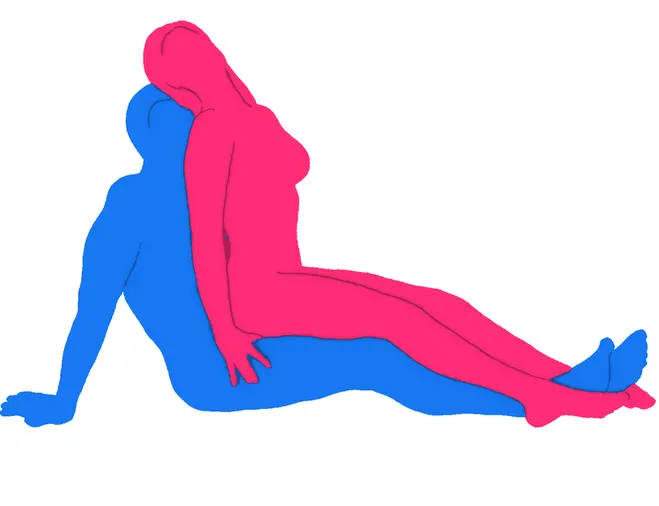
The Archer is a sexual position that allows for deep penetration and an intimate face-to-face connection. Ideal for exploring different rhythms and angles of stimulation.
Also known as: Sagittarius / Archer Position / Arrow Position
Variations of this position
Forward-leaning variant
The receptive person leans slightly forward, allowing for deeper penetration and a different angle of stimulation.
- The receptive person stands with legs slightly apart.
- The penetrating person stands behind, holding the hips of the receptive person.
- The receptive person leans slightly forward, allowing for deeper penetration and a different angle of stimulation.
Variant with support on a surface
The receptive person leans on a surface, such as a table or the edge of the bed, for greater stability and comfort.
- The receptive person stands in front of a stable surface, such as a table or the edge of the bed.
- The penetrating person stands behind, holding the hips of the receptive person.
- The receptive person leans slightly forward, leaning on the surface for greater stability and comfort.
Variant with circular movements
The penetrating person makes circular movements instead of linear ones, providing different and more intense stimulation.
- The receptive person stands with legs slightly apart.
- The penetrating person stands behind, holding the hips of the receptive person.
- The penetrating person makes circular movements instead of linear ones, providing different and more intense stimulation.
✓ Tips
- Make sure to use lubricant for greater comfort and to reduce friction.
- Maintain open communication with your partner to adjust the depth and rhythm according to your preferences.
- Use pillows or supports to maintain a comfortable and stable position.
- Avoid sudden movements that may cause discomfort or pain.
Key facts
- Interaction type
- vaginal sex, anal sex
- Active anatomy
- Penis / Vulva / Fingers
- Receptive anatomy
- Vagina / Anus
- Main stimulation
- G-Spot / A-Spot
- Setups and participants
- Couple · 2 people Hetero
Frequently asked questions
Is this position suitable for beginners?
Yes, as long as the rhythms are adjusted and lubricant is used for greater comfort.
Can it be performed in different positions?
Yes, this position is very versatile and can be adapted to different angles and positions according to the couple's preferences.
Which body areas are primarily worked on?
Primarily, the core, gluteal, and leg muscles are worked, depending on the support and specific position.
Safety and evidence
Scientific context for common terms used on this page. Keeping these terms makes the content easier to understand; the sources clarify what is established and what remains uncertain.
G-spot: what the evidence says
“G-spot” is a widely used term for a sensitive area of the anterior vaginal wall. Scientific literature has not established a discrete anatomical structure with an agreed location, size and nature; sensitivity and response can vary between individuals.
A-spot / AFE zone: limited evidence
The “A-spot” or AFE zone has been proposed to describe a deeper area of the anterior vaginal wall. Available evidence is limited and does not support presenting it as a confirmed anatomical structure.
Last editorial review:
Related sex positions

The Celestial Bridge

Doggy on the edge

Rear Admiral

Sensual Touch

Mature Lady

The Bull

The Hook

The Grasshopper

Multiply Pleasure
The Rocking

Bright Moon
