

Anatomy and biomechanics
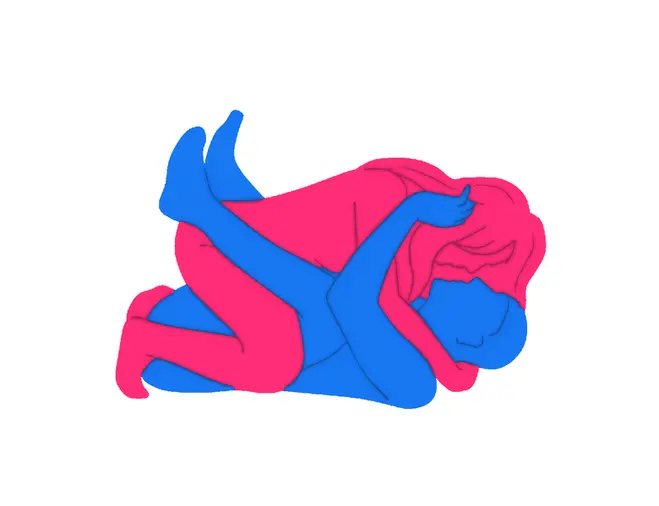
In this position, both bodies are sitting face to face, with legs intertwined. She sits on top of him, allowing for medium penetration. The height and supports (pillows, edge of the bed) can be adjusted to maintain comfort and stability.
Why this position works
This position allows for intense visual and physical connection, facilitating communication and mutual control of the rhythm and depth of penetration.
Tug of War: Complete Guide to the Interactive Sexual Position
The Tug of War position is an interactive sexual position where both bodies are arranged astride, sitting, with her on top. This position allows for medium penetration and a focus of stimulation on the G-spot and the A-spot.
Also known as: Tug of war/Face-off/Rope position
Variations of this position
Tug of War with Twists: Adding Circular Motion
In this variation, circular hip movements are added to increase stimulation.
- Sitting face to face, she sits on top of him and they interlock their legs.
- Start with medium penetration and adjust the height with pillows if necessary.
- While maintaining the rhythm, add circular hip movements to stimulate different areas.
Tug of War with Hand Support: More Control and Stability
In this variation, she supports herself with her hands to have more control over the movement.
- Sitting face to face, she sits on top of him and they intertwine their legs.
- She supports herself with her hands behind her to have more control and stability.
- Start with medium penetration and adjust the rhythm and depth according to both of your pleasures.
Tug of War with Legs Elevated: Increased Depth
In this variation, she elevates her legs to allow for deeper penetration.
- Sitting face to face, she sits on top of him and they intertwine their legs.
- She lifts her legs and places them over his shoulders to allow for deeper penetration.
- Adjust the rhythm and depth according to both of your pleasures, maintaining constant communication.
✓ Tips
- Make sure to adjust the height with pillows or cushions to avoid tension in the lower back.
- Maintain constant communication to adjust the rhythm and depth according to both partners' pleasure.
- Avoid abrupt movements that could cause imbalance or discomfort.
- Use lubricant to facilitate penetration and reduce friction.
Key facts
- Interaction type
- Interactive
- Active anatomy
- Penis
- Receptive anatomy
- Vagina
- Main stimulation
- G-spot / A-spot
- Setups and participants
- Couple · 2 people Hetero
Frequently asked questions
Is this position suitable for beginners?
Yes, it is a suitable position for beginners due to its interactive nature and the control it allows over the rhythm and depth.
How can I increase the intensity of pleasure in this position?
You can increase the intensity of pleasure by moving the hips in circles or adjusting the angle of penetration to stimulate different areas.
Is it possible to perform this position on different surfaces?
Yes, this position can be adapted to different surfaces, such as a bed, sofa, or even the floor, as long as comfort and stability are ensured.
Safety and evidence
Scientific context for common terms used on this page. Keeping these terms makes the content easier to understand; the sources clarify what is established and what remains uncertain.
G-spot: what the evidence says
“G-spot” is a widely used term for a sensitive area of the anterior vaginal wall. Scientific literature has not established a discrete anatomical structure with an agreed location, size and nature; sensitivity and response can vary between individuals.
A-spot / AFE zone: limited evidence
The “A-spot” or AFE zone has been proposed to describe a deeper area of the anterior vaginal wall. Available evidence is limited and does not support presenting it as a confirmed anatomical structure.
Last editorial review:
Related sex positions

Heart Link

The Pleasure Generator

Oriental Art
The Fifth Element

Frog Style

Princess Elevated

Side Saddle

The Nest

The Whispering Embrace

Deeply Embracing

Reverse Cowgirl
